
What are terpenes?
Did you know that the fresh scent of a lemon 🍋, the calming aroma of lavender 🪻, and even the sticky resin of pine trees 🌲 all come from the same family of natural compounds?
Meet terpenes, hidden and amazing compounds!
1. Definition : what are terpenes?
Terpenes, terpenoids or isoprenoids conform the largest group of natural products, with over 100.000 molecules identified to date. They are at the same time general metabolites and also the largest group of specialised metabolites. Many of them are aromatic and are responsible for the scent and taste of many plants.
|
|
Metabolites are organic compounds, in other words, direct products of metabolism. Specialised metabolites, unlike general metabolites, are not directly involved in growth, development and reproduction, but play a crucial role in the adaptation of organisms to their environment and ensure their survival. Thus, terpenes arise from metabolic processes, meaning from the functioning of the organism. |
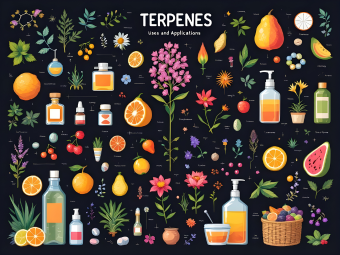
2. What is the difference between terpenes and terpenoids?
Terpenes are a subgroup of terpenoids. Terpenoids possess many atoms but terpenes only contain hydrogen and carbon atoms. Though the terms are often used without this discretion.
3. Classification of the main terpene families among aromatics
Terpenes are made up of 5-carbon units, called C5, which are associated with each other. The classification of terpenes and terpenoids is based on the number of initial units:
|
Monoterpenes: composed of 2 units (i.e. 10 carbon atoms) Such as geraniol, which is very present in the scent of roses, or limonene, which is found in large quantities in citrus fruits. |
| ||
|
Sesquiterpenes: composed of 3 units (i.e. 15 carbon atoms) Such as farnesene, which gives green apples their scent, or humulene, which is found in sage or ginseng. |
| ||
|
Diterpenes: composed of 4 units (i.e. 20 carbon atoms) Such as abietic acid found in the resin of many conifers or cafestol found exclusively in coffee trees. |
| ||

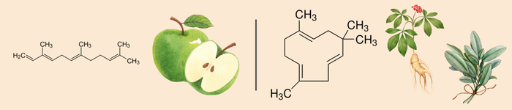

This classification then extends from 5 to 5 for sesterpenes (25 atoms), triterpenes (30 atoms), tetraterpenes (40 atoms) and polyterpenes, which have more than 40 carbon atoms, such as natural rubber.
4. Terpenes: where can they be found?
Terpenes are found in all living organisms on this planet. They are formed in these different organisms by fairly biosynthetic processes, i.e. the way in which the cell makes the molecule, but with small differences that makes each organisms individual and provide different metabolites.
5. Role of terpene in plants as specialized metabolites
As metabolites dedicated to survival and adaptation, terpenes play in general three major and essential roles for plants:
Defence against pests
Contrary to what you might think when you see the thorns on some plants, their first line of defence is invisible to the eye, and often it is the terpenes hat play this role. So, it's a chemical defence. Terpenes act as repellents against many insects, herbivores and organisms that are harmful to plants. Some of these compounds are also used in the health and hygiene sector for their repellent, antibacterial, antifungal properties, etc...
Pollinators attraction
Terpenes repel certain insects... and attract others that are essential to plants like pollinators, without which plants could not reproduce.
Communication and ecological interactions
It is partly via terpenes that plants communicate with each other. The emission of this or that compound by a plant can alert and indicate to its fellow plants the presence of an enemy (herbivore, pest, etc.) or even attract an enemy of the enemy! In this way, neighbouring plants can anticipate an attack by strengthening their chemical defences.
|
|
|
|
|
Défense |
Attraction |
Interaction |
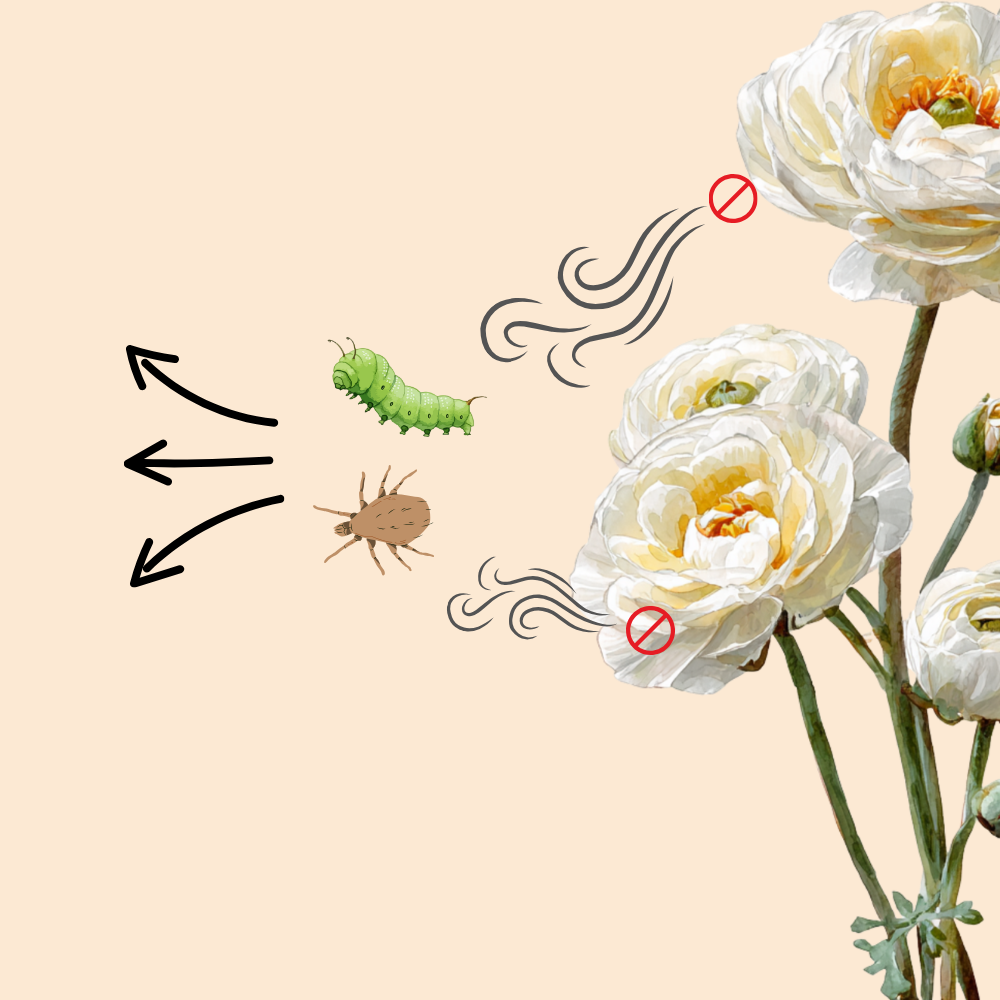
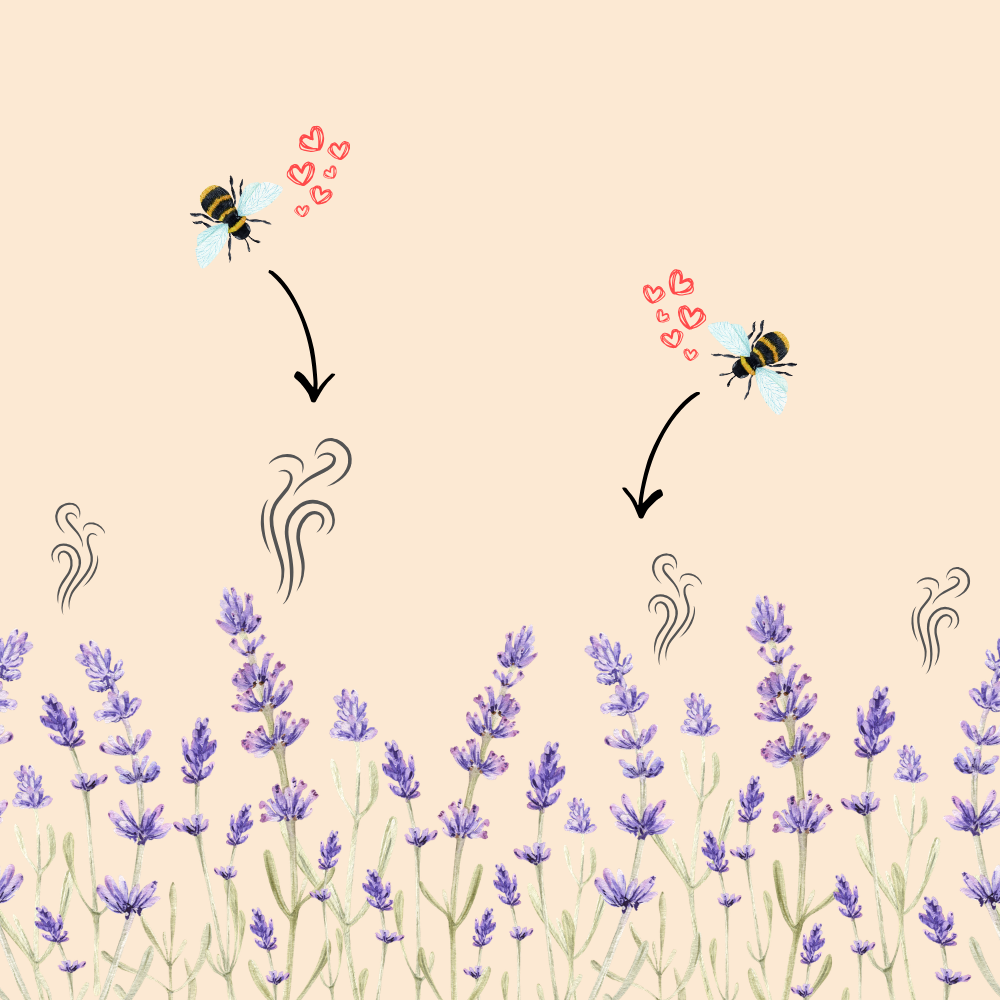
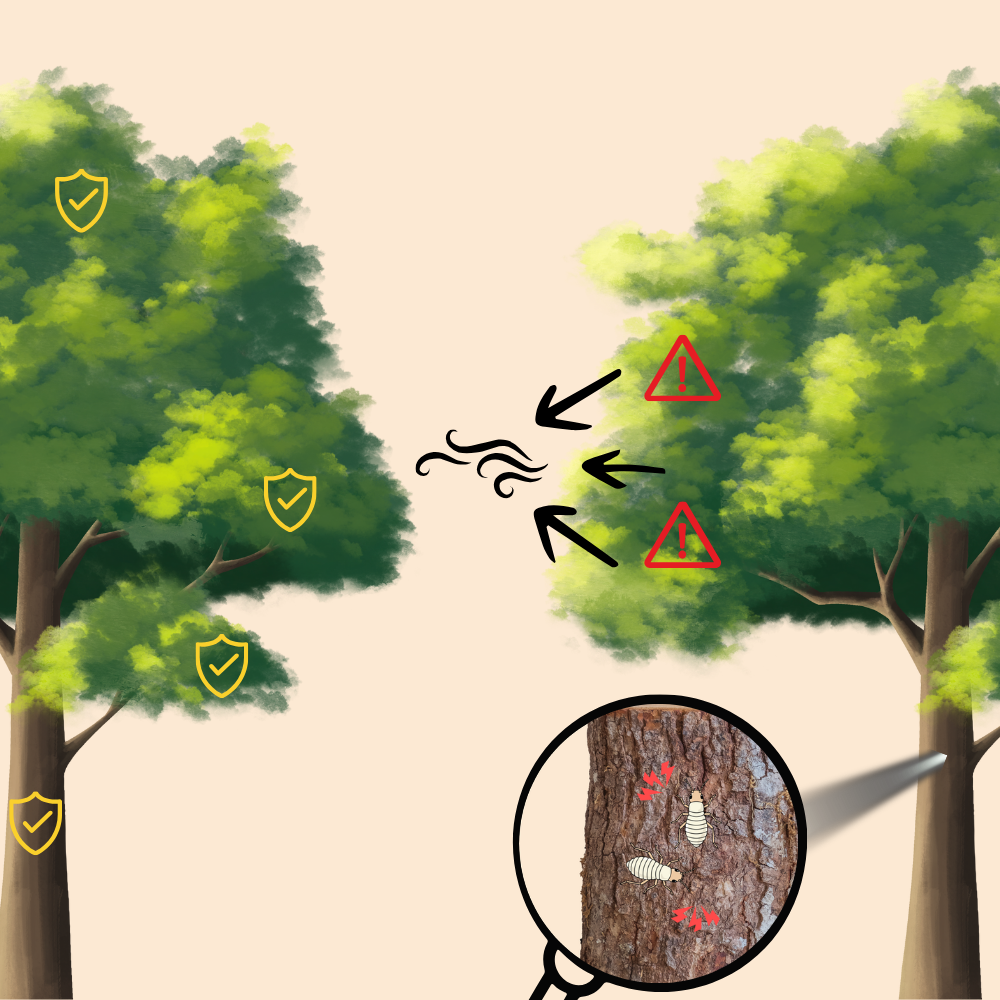
The powerful fragrances of certain plants are not just there to delight or surprise your sense of smell, but above all to convey information that is crucial to the plants themselves!
6. Use of terpenes: perfumery, cosmetics, health and species (food)
Aroma and flavour
Terpenes from plants have been used for their aroma and flavour for thousands of years. The earliest registered use of aromatic plants by humans in archaeology dates back to prehistoric times, with some of the most compelling evidence found at the Shanidar Cave in Iraq. Here, researchers discovered flower pollen in a Neanderthal burial site dating back approximately 60,000 years ago. This suggests that Neanderthals may have used aromatic plants, possibly for ritual or medicinal purposes.
Likewise, the earliest and most compelling archaeological evidence for the use of aromatic and terpene containing plants like yarrow (Achillea millefolium) and chamomile (Matricaria chamomilla) by humans comes from Neanderthal sites in northern Spain, specifically El Sidrón Cave, dating back approximately 49,000–50,000 years ago. Here researchers extracted biomolecular evidence (like the azulene, which comes from chamomile) from the dental calculus (tartar) of a Neanderthal individual at El Sidrón. Both Yarrow and chamomile have and are widely used for their health promoting properties, which in part is due to terpenes¹.
Cosmetics and perfumery
In cosmetics, the earliest documented use of roses and other essential oils for cosmetics dates back to Mesopotamia (5000-3000 BCE) and Egypt (4500 BCE), where they were integral to beauty, skincare, and religious practices. Thus, there is a long tradition to use terpenes in cosmetics. Today, the cosmetic and perfume industry uses terpenes for one obvious reason: their fragrance. For example, linalool, responsible for the scent of lavender, geraniol, responsible for the scent of roses, and citronellol, responsible for the scent of lemongrass, are highly prized terpenes.
Health
The pharmaceutical, aromatherapy and chemical industries also exploit many terpenes for their antibacterial, antifungal and anti-inflammatory properties. These compounds can be found in your medicines or cleaning products.
7. Terpenes at the heart of LBVpam research
The LBVpam specialises in the study of terpenes from aromatic and medicinal plants. The range of studies has subsequently broadened, and these compounds are now studied in all linages of plants including lavender, pelargonium, rose, petunia, arum and liverworts.
The LBVpam's research aims to understand how these compounds are produced and transported within the plant, to gain a better understanding of their ecological role and enable biotechnological production of valuable terpenoids.
References
1. Hardy K. Paleomedicine and the Evolutionary Context of Medicinal Plant Use. Rev Bras Farmacogn. 2021;31(1):1-15. doi: 10.1007/s43450-020-00107-4. Epub 2020 Oct 9. PMID: 33071384; PMCID: PMC7546135.
 Université Jean Monnet