
The secrets of the scent of plants 👃What are they and what are their roles?
Why doesn't a rose smell like lavender 🌹🪻? What makes up these very specific scents? How is our nose able to tell the difference between different smells 👃? How are they analysed in the laboratory 🔍?
Embark on an odyssey of plant scents!
1. The Chemistry of the Invisible: what is a smell made of? 🔎
Scents are more or less complex mixtures of molecules emitted by a source, such as a flower, which are released into the air. These molecules are called volatile organic compounds (VOCs), in other words, they will evaporate at room temperature. It is important that these molecules are volatile, as this is what allows them to be detected by the senses of other species.
A smell is therefore not a single entity, but a bouquet of many molecules that together create a very specific fragrance, like an orchestra: each instrument represents a specific molecule which, when combined, creates a symphony called a smell.
There are different families of fragrant molecules. At LBVpam, the focus is on terpenes (to understand what a terpene is, see our dedicated article).
So, regarding the difference between the scent of rose and lavender, they are so different because the molecules that compose them are themselves very different:
|
Main molecules present in rose |
Main molecules present in lavender scent 🪻 | ||
|
β-Citronellol + around 100 molecules |
|
Linalool + around 30 molecules |
|


2. Human perception: molecules, nose and brain 👃
Your nose is always working, detecting odours around you. When you breathe in, tiny odour molecules are drawn into your nose and reach a special area at the top of your nasal cavity, between your eyes. This area, called the olfactory epithelium, contains around 50 million odour-sensitive cells, they are the olfactory neurones.
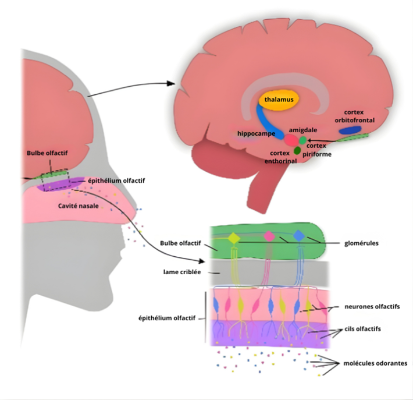
Illustration created by Arnaud Fournel under CC-BY-NC-SA licence, GDR03 website. Source: https://www.gdr-o3.cnrs.fr/faq/#Mini-serie_danimation.
Each of these cells has tiny hair-like structures called cilia that react to odour molecules thanks to receptors located on their surface. When a molecule encounters a suitable receptor, it triggers a signal that travels to your brain — first to the olfactory bulb, then to the areas responsible for recognising scents and associating them with your memories and emotions[1].
To understand smell, the brain does not interpret each molecule specifically, but rather interprets a combination of signals, like a piano chord: each note/molecule is individual, but when analysed together, they create a chord/smell.
Thus, all of the molecules emitted by the rose will simultaneously activate receptors that are very different from those activated by the volatile molecules emitted by lavender. Our nose will therefore transmit a unic message to our brain for each cocktail of molecules it perceives.
3. Perception in plants and insects 🌱🐝
VOCs are released by all living things: animals, plants and even bacteria and fungi, and enable information to be transmitted between the same species and with other species, in the air and in the soil.
How do plants 'smell"? 🌱
Plants are constantly exposed to VOCs, whether in the air or in the soil. Sometimes these compounds carry no message, and sometimes they do. We do not yet fully understand how plants receive and analyse these messages, or how they develop a strategy to respond to them. But this mechanism does exist in plants. Researchers are currently working on this topic to better understand how it works.
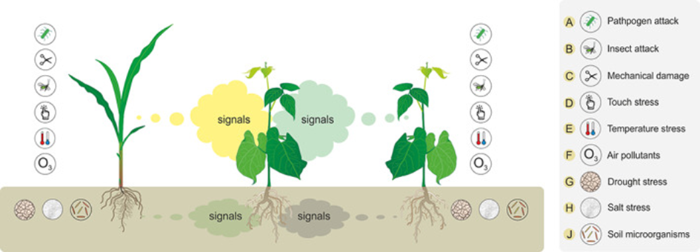
Volatile signals emitted underground and above ground released by plants as a result of: A, a pathogen attack; B, an insect attack; C, mechanical damage; D, touch stress; E, temperature stress; F, air pollutants; G, drought stress; H, salt stress; or J, soil microorganisms. Biotic stresses (resulting from another living organism) and abiotic stresses (resulting from a change in the environment) encountered by plants cause them to release specific volatile molecules that carry precise messages. When this message is perceived by another plant, it allows it to react quickly enough to deal with the imminent threat/stress. [The colour figure can be viewed at wileyonlinelibrary.com].[2]
How do insects perceive scent? 🐝
Insects, ‘smell’ VOCs thanks to chemical receptors located generally (but not always) on their antennae, in tiny sensory hairs called olfactory sensilla. This is the insect's ‘nose.’ Their olfactory system therefore works in much the same way as ours.
4. Expertise and technical study of scent in the laboratory: extraction and analysis 🧪
At LBVpam, we move from extraction to identification in order to map ‘olfactory profiles’, i.e. the composition of scent.
Scent extraction can be carried out in various ways:
- Dynamic headspace: this technique can be used in real-world environments or in laboratories. It captures molecules emitted into the air by plants.
- Solvents: this technique requires handling to be carried out exclusively in a laboratory and captures molecules stored directly in the plant's cells.
|
|
|
|
|
VOC capture by dynamic headspace in outdoor environments |
Solvent extraction |
VOC capture by dynamic headspace at the laboratory |
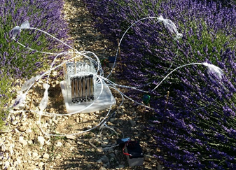

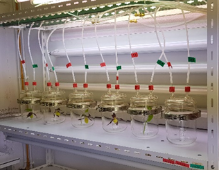
Once the extraction has been carried out, the aim is to analyse the scent in order to identify the molecules that compose it. To do this, several tools are used at LBVpam:
- GC-MS (gas chromatography): this tool is used on volatile molecules. They are introduced into the machine, which sorts them according to different characteristics and quantifies them. The result is a spectrum, a graph representing all the molecules detected in the analysed scent and their concentration.
- LC-MS (liquid chromatography): gives the same result but on non-volatile molecules.
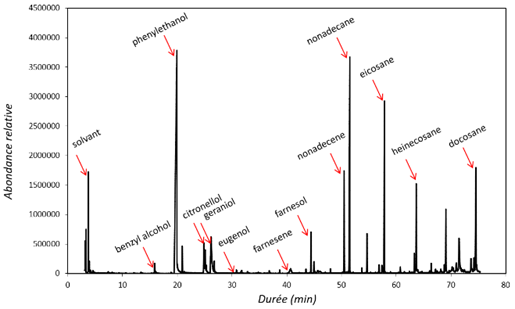
GC-MS spectrum: result of a GC-MS analysis performed on a rose scent. The ordinates represent relative abundance, i.e. the quantity of the molecule present in the analysed scent. The x-axis represents time: each molecule has specific characteristics and therefore takes more or less time to reach the analysis point, which allows the machine to determine its identity.
These techniques are part of the science known as metabolomics, which studies general metabolites (directly responsible for the proper functioning of organisms) and specialised metabolites (responsible for their adaptation to the environment and their survival). The molecules responsible for plants scent are mostly specialised metabolites.
The data generated is then studied using bioinformatics and statistics.
All these techniques help us understand the biosynthesis (how the plant produces scented molecules in their cells) and are the first step towards understanding the role the emission of these molecules plays in the environment.
Références 📖
[1] Sharma A, Kumar R, Aier I, Semwal R, Tyagi P, Varadwaj P. Sense of Smell: Structural, Functional, Mechanistic Advancements and Challenges in Human Olfactory Research. Curr Neuropharmacol. 2019;17(9):891-911. doi: 10.2174/1570159X17666181206095626. PMID: 30520376; PMCID: PMC7052838.
[2] Ninkovic V, Markovic D, Rensing M. Plant volatiles as cues and signals in plant communication. Plant Cell Environ. 2021 Apr;44(4):1030-1043. doi: 10.1111/pce.13910. Epub 2020 Oct 26. PMID: 33047347; PMCID: PMC8048923.
 Université Jean Monnet